

The secret of getting ahead is getting started. The secret of getting started is breaking your complex overwhelming tasks into small manageable tasks, and starting on the first one.
– Mark Twain
From Overwhelm to Action
Ever wondered how to kickstart a goal when your motivation takes a snooze…?
Living with ADHD can often feel like navigating a maze filled with countless distractions, overwhelming tasks, and moments of paralysis where it’s hard to even begin. Since you arrived on this blog, you might already be aware of this all too common experience of finding yourself stuck in a state of inaction, despite every good intention to move forward. You. Just. Can’t.
For many women with ADHD, finding strategies to stay motivated, build discipline, and create productive routines can be challenging but incredibly rewarding – and the difference between forward momentum and sitting in a parked car getting nowhere.
Today, we’re exploring practical, actionable tips to help you overcome task paralysis and kickstart your journey toward achieving your goals.
To bring these strategies to life, we are sharing 10 stories showcasing how women with ADHD have tackled common hurdles and kickstarted their progress when feeling stuck.
BUT FIRST… a confession.
I’ll admit, getting this first blog post published has been a journey in itself. 😳 The very challenges we explore in this article have contributed to the delay. As the founder of Poppique (a name that reflects our mission of bringing explosively creative popcorn minds to peak performance), authenticity is key. Understanding these struggles firsthand means this is more than a guide – it’s a shared experience. So I want to thank you for joining me as together we learn new ways to unleash our productivity and fall in love with our brilliant, beautiful kernels.
Now, let’s dive into these tips and see how you can transform your productivity. 💙
TL;DR: Key Tips for Overcoming Task Paralysis with ADHD
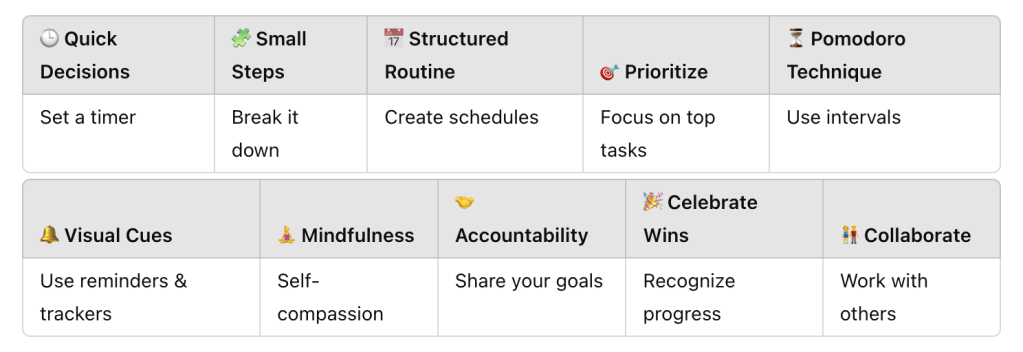
- Quick Decisions: Use a timer to avoid overthinking.
- Small Steps: Break tasks into manageable parts.
- Structured Routine: Create daily and weekly schedules.
- Prioritize: Focus on high-priority tasks first.
- Pomodoro Technique: Work in short, focused intervals with breaks.
- Visual Cues: Use reminders, habit trackers, and checklists to stay organized.
- Mindfulness: Practice self-compassion to manage stress & perfectionism.
- Accountability: Share goals with a supportive person.
- Celebrate Wins: Recognize small achievements.
- Collaborate: Work with others to leverage strengths.
If we wait until we’re ready, we’ll be waiting for the rest of our lives, let’s go.
– Lemony Snicket, The Ersatz Elevator
#1. Eliminate choice and decision-making with speed
Problem: Kiera often gets stuck in indecision, spending too much time contemplating choices.
Solution: Keira sets a timer for a short period (e.g., 10-15 minutes) to quickly commit to making rapid decisions and progress during that time, knowing she can adjust later. This eliminates overthinking and analysis paralysis, allowing her to keep moving forward.
#2. Break tasks into smaller steps
Problem: Elara feels overwhelmed by large tasks and struggles to start and complete them.
Solution: Elara breaks tasks into smaller, more manageable steps to reduce overwhelm and make progress more achievable, easier to follow, and less daunting. She writes down each step and creates visual reminders, focusing on completing one step at a time rather than the entire task at once. To stay on track, Elara sets deadlines for each smaller step and schedules them into her calendar for better visibility and accountability.
#3. Create a structured routine
Problem: Junie’s days feel chaotic, disorganized and reactive (not proactive), leading to procrastination, stress and even shame for (ugh) falling behind again. She feels overwhelmed and struggles to get started, often getting stuck in a cycle of inactivity.
Solution: Junie establishes a daily and weekly structured routine with designated time slots for different activities (including breaks!) The consistent routine helps improve productivity and reduce decision fatigue and overwhelm. She also uses external reminders and timers to stay on track and ensure she transitions smoothly between tasks, preventing her from getting trapped on one task for too long (hello, time blindness 👋).
#4. Prioritize tasks based on importance
Problem: Amara struggles with prioritizing tasks and often feels overwhelmed by a seemingly never-ending to-do list. Never being able to complete an overly exhaustive and unachievable to-do list leaves her feeling bad about herself and undermines her sense of self-worth, which prevents her from trying to promote herself professionally.
Solution: Amara ranks tasks by urgency and importance, focusing first on her top three daily priorities – no matter what, those will get done. She schedules medium-priority tasks within the week and tracks lower-priority tasks on index cards in a “TO DO LATER” box, so they don’t fall through the cracks. (An ever-present Thought Dump mini journal is another great solution!) This method prevents overwhelm and ensures essential tasks are addressed promptly, boosting her confidence and sense of accomplishment.
#5. Implement the pomodoro technique:
Problem: Leilani has difficulty maintaining focus and often experiences restlessness and burnout during long work sessions. Conversely, she sometimes gets “stuck”, hyperfocused in one activity for longer than necessary and runs out of time to get to other tasks.
Solution: Leilani uses the pomodoro technique to work in focused, intentional intervals (e.g. 25 minutes) followed by short breaks (e.g., 5 minutes). This structured approach can increase productivity and prevent burnout by balancing work and rest periods. (A cute analog timer with adjustable volume can be particularly helpful for sensitive ears and gently awakening from hyperfocus.)
#6. Overcome organizational blocks with visual cues and adaptive tools
Problem: Ruby frequently experiences executive dysfunction, resulting in challenges with task organization, time management, and remembering appointments or deadlines. This disorganization leads to missed deadlines, a sense of chaos, and a tendency to give up prematurely before finding a starting point. As a result, she feels stuck and unable to move forward with new tasks.
Solution: Ruby implements visual cues like sticky notes, checklists, habit trackers, and digital reminders to stay organized and on track with tasks. These visual cues serve as prompts and reduce reliance on memory or decision-making. Additionally, she explores adaptive and assistive technologies such as digital calendars with reminders, task management apps with customizable features, and time-blocking techniques tailored to her ADHD needs. By using these tools and strategies, Ruby overcomes organizational blocks, improves her time management, and enhances her productivity.
#7. Embrace mindfulness, flexibility, and self-compassion to overcome perfectionism
Problem: Mina grapples with perfectionism, leading to high levels of stress and self-criticism, especially when tasks become challenging or when she is terrified of failure and judgment for missteps. This perfectionistic mindset often results in frustration and burnout, making it difficult for her to approach tasks with a positive and productive mindset.
Solution: Mina adopts mindfulness, flexibility, and self-compassion as tools to manage perfectionism and foster progress. By practicing mindfulness techniques like deep breathing and meditation, she stays present and effectively manages stress. Additionally, Mina practices self-compassion by acknowledging challenges without self-judgment or criticism. She embraces flexibility, adjusting goals as needed, and prioritizes progress over perfection. This approach empowers Mina to overcome perfectionism’s grip, promoting resilience and well-being as she navigates her tasks with a positive and adaptive mindset.
Remember, embracing imperfections fosters growth!
#8. Seek accountability and support
Problem: Despite feeling enthusiastic at the outset, Hazel often finds herself stuck and lacking motivation when working on personal goals. This makes it challenging for her to stay accountable and make consistent progress.
Solution: Hazel decided she would share her goals with a supportive friend, family member, or mentor who could provide encouragement and accountability. By confiding in someone, she not only makes her goals real by saying them aloud “publicly” but also takes responsibility for her progress. Their support helps keep her accountable and motivated. Regular check-ins with this support system help her maintain motivation and momentum, making it easier for Hazel to kickstart her progress.
Need help? Consider hiring an ADHD coach if affordable, or joining online groups connecting women with ADHD for additional support and accountability.
#9. Celebrate small wins
Problem: Beth often becomes stuck in a cycle of discouragement and stagnation because she overlooks her progress and focuses solely on unfinished tasks. This negative mindset hinders her ability to see the value in small achievements and leads to a lack of motivation to continue moving forward.
Solution: Beth shifts her perspective and actively acknowledges and celebrates small achievements, no matter how minor they may seem. This change in mindset boosts her confidence and motivation, breaking the cycle of stagnation and encouraging her to keep working towards her goals. Remember: self-confidence grows when you recognize and celebrate the progress you make, no matter how small.
#10. Collaborate to leverage strengths (…in other words, ask for help 😉)
Problem: Riley often gets stuck and struggles when working in isolation, feeling she must do everything herself. This isolation, driven sometimes by ego 🙃 or fear of asking for help, results in slow or stalled progress and increased frustration.
Solution: Riley sets her ego aside and collaborates with others who have complementary strengths. By working with others, she doesn’t have to do everything herself, and collaboration often elevates the end results. She adopts a new persona, “Collaborative Riley,” to remind herself of the value of seeking help and the benefits of teamwork – and intentionally gives permission for Collaborative Riley to ask for help, even if regular Riley has trouble doing so…. This approach helps her move forward more effectively and reduces the feelings of isolation and overwhelm.
If you’re feeling stuck, consider finding a partner or team whose strengths complement your own to enhance your productivity and achieve better outcomes.
FLIP THE SCRIPT
Instead of thinking, “I’m overwhelmed and stuck,” think “I am learning to break tasks into manageable steps and make progress.”
DAILY CHALLENGE
Reflect on Achievements: Take a moment to reflect on one thing you’ve accomplished recently, no matter how big or small, and celebrate your progress.
Share your achievement in the comments if you’re open to it – we’d love to celebrate with you!
As you implement these strategies into your daily life, remember that progress is made one step at a time.
Well-being is realized by small steps, but is truly no small thing. – Zeno
What’s your top tip for overcoming task paralysis? Share your thoughts in the comments below – we’d love to hear from you and learn from each other’s experiences.

Looking for ADHD-Friendly Fitness & Wellness Ideas? 💌
Join a community that understands your unique energy and needs as an ADHD sister. Receive monthly tips, creative movement ideas, fitness inspiration and routine-building strategies to help you stay active, focused, and fulfilled—one small step at a time.
👉 Sign up for our newsletter and start making wellness work for you today! ✨
Resources:
- PODCAST: Girls Who Excel – Morning Routines That Crush Procrastination (6 min)
- PODCAST: The Daily Motivation featuring Mel Robbins – CRUSH Indecision in 5 Seconds (7 min)
Comments