
The Strength You’re Probably Not Training
When you think about getting stronger, what comes to mind?
Squats? Deadlifts? Strong arms? Maybe finally being able to do a push-up without immediately regretting your choices?
Probably not your hands.
Grip strength is one of those quietly important parts of fitness that most of us don’t think about until something makes us notice it: a stubborn jar lid. Heavy grocery bags. A dumbbell your legs could absolutely handle if your hands would just cooperate.
But your ability to grip, hold, carry, pull, twist, and squeeze is involved in a surprising amount of what you do… both inside and outside the gym.
And those muscles deserve some attention, too.

Why does grip strength matter?
Your grip relies on muscles and tendons throughout your hands, fingers, wrists, and forearms working together.
You use them constantly: carrying groceries, opening containers, picking up a suitcase, holding a dog’s leash, gardening, moving things around the house.
In the gym, your grip is working whenever you’re holding a dumbbell or kettlebell, doing rows, deadlifts, lat pulldowns, pull-ups, or loaded carries.
Sometimes your grip can even become the limiting factor in an exercise. Your back or legs may have more to give, but your hands are already saying:
Nope. We’re done here.
There’s also a bigger reason researchers pay attention to grip strength.
Handgrip strength, typically measured with a device called a dynamometer, is often used as a simple indicator of overall muscular strength and physical function. Research has found associations between lower grip strength and disability, cardiovascular and all-cause mortality, although that doesn’t mean your grip itself is a magical predictor, or that squeezing a tennis ball will make you live longer.
Think of grip strength more like one useful clue about the bigger picture of strength and function.
It also tends to decline as we get older. One NIH-supported study of healthy adults over 50 found dominant-hand grip strength declined by nearly 4% per decade.
Another good reason to keep getting stronger as we age.
6 simple ways to improve your grip strength
Good news: you do not need to add “Grip Day” to your workout schedule. 😄
Try adding one or two of these exercises to a strength workout or sprinkling a few into your day at home.
1. Farmer’s Carries
Hold a moderately heavy dumbbell or kettlebell in each hand. Stand tall, brace your core, and walk slowly and with control.
Try: 20–40 seconds, rest, and repeat for 2–3 rounds.
No gym? Carrying heavy grocery bags counts.
Why I like it: You’re training your grip while also challenging your shoulders, core, and postural muscles – and practicing a movement you actually use in real life.
Plus, carrying all the grocery bags inside in one trip is practically a competitive sport.
2. Towel Wrings
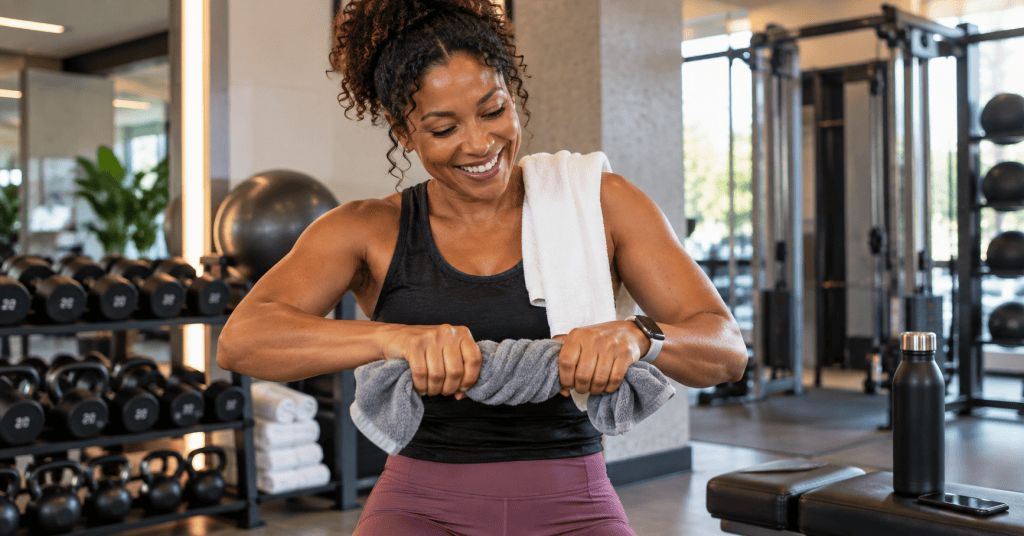
Grab a small hand towel – dry works, but damp adds a little resistance. Roll or bunch it lengthwise, then grip one end in each hand.
Twist your hands in opposite directions, just like you’re wringing water out of a wet towel. Squeeze and twist firmly, then reverse directions.
Try: 20–30 seconds in each direction for 2–3 rounds.
It’s simple, requires no special equipment, and challenges your grip and forearms through a twisting motion you don’t always get from traditional strength exercises.
3. Ball Squeezes
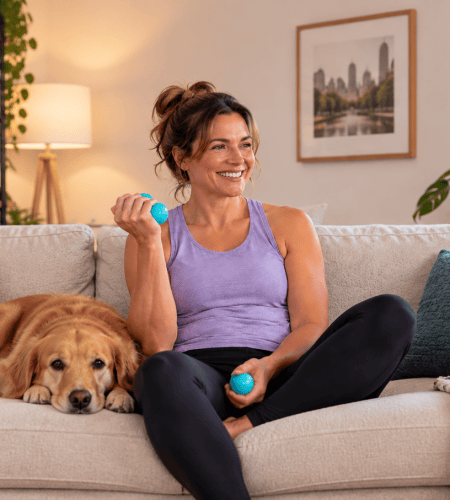
Grab a tennis ball, stress ball, or soft hand-training ball.
Wrap your fingers around it, squeeze firmly, hold for about five seconds, then slowly release.
Try: 8–12 squeezes per hand.
And no need to frantically squeeze it 75 times while answering emails. Slow, intentional repetitions are the goal.
4. Dumbbell Wrist Curls
Sit with a light dumbbell in each hand and rest your forearms on your thighs, palms facing up. Let your wrists extend just beyond your knees.
Keeping your forearms still, slowly lower the weights by extending your wrists, then curl them back toward you.
Try: 10–15 controlled reps.
Start lighter than you think (e.g. 2 or 3 pounds). Your wrists do not need your ego involved in this exercise.
5. Reverse Wrist Curls
Same idea – now flip your hands so your palms face down.

Slowly lower and raise the dumbbells using your wrists while keeping your forearms supported.
Try: 10–15 controlled reps.
Wrist curls emphasize the muscles on the palm side of your forearm, while reverse curls give more attention to the wrist extensors on the other side.
6. Dumbbell Finger Rolls
Sit with your forearms supported and palms facing upward. Hold a light dumbbell in each hand.
Slowly allow the dumbbell to roll toward your fingertips without losing control, then curl your fingers around it and squeeze it back into your palm.
Try: 8–12 slow reps.
The movement is small. Your forearms may disagree. 😉
And definitely start light. We’re strengthening your fingers, not testing how loudly a dumbbell can hit the floor.
Bonus: Dead Hangs
Ready to level up your grip work? Try hanging around. (Literally.)
A dead hang challenges your grip in a different way: instead of squeezing or moving a light weight, your hands and forearms have to maintain their grip while supporting your body weight.
Grab a secure overhead bar with both hands, roughly shoulder-width apart. With a controlled grip, hang from the bar while keeping your shoulders engaged rather than completely collapsing into them. (IMPORTANT: Avoid forcing a position that feels uncomfortable in your shoulders.)
Try: Start with 5–10 seconds and gradually work toward longer holds as your grip gets stronger. If supporting your full body weight is too much right now, keep your feet lightly supported on the floor, a box, or another stable surface and build from there.
Why I like it: Dead hangs challenge grip endurance while also involving the shoulders and upper body. They can also be a useful stepping stone toward exercises like pull-ups.
But this one’s a progression. You don’t need to be able to hang from a bar to start improving your grip strength. Begin with the exercises above and work your way up if a dead hang is something you’d like to try.
You may already be training your grip
Here’s the nice part: if you’re strength training regularly, you’re probably already doing some grip work.
Rows. Deadlifts. Kettlebell exercises. Lat pulldowns. Carries. Even holding dumbbells during lunges.
They all require your hands and forearms to maintain a grip against resistance.
And you don’t need a complicated program to get stronger. The American College of Sports Medicine’s 2026 resistance-training guidance emphasizes something we happen to like very much around here:
Consistency beats complexity.
Try this tiny grip-strength finisher
Want to make it extremely easy?
At the end of your next strength workout:
Farmer’s carry: 30 seconds
Towel wrings: 20 seconds each direction
Ball squeezes: 8–10 per hand
Rest and repeat once.
That’s it.
You don’t need to do all six exercises. You don’t need fancy equipment. You don’t need a 30-day Grip Strength Challenge.
Just give an often-overlooked part of your body a little more attention.
Because some of the most useful kinds of strength aren’t particularly glamorous.
They’re the strength that helps you carry something heavy. Open something stubborn. Hold onto a weight. Pick something up. And keep doing everyday things independently as you get older.
Strong is useful. And sometimes, getting stronger starts with simply holding on.
💛 A quick safety check:
Have hand, wrist, elbow, or forearm pain or an existing injury or condition? Check with an appropriate healthcare professional before adding grip-specific exercises, and stop any exercise that causes pain.

Ready for more mind-body magic and ADHD-friendly fitness & wellness Ideas? 💌
Join a community that understands your unique energy and needs as an ADHD sister. Receive monthly tips, creative movement & momentum ideas, fitness inspiration and routine-building strategies to help you stay active, focused, and fulfilled—one small step at a time.
👉 Sign up for our newsletter and start making wellness work for you today! ✨
Comments