

Yoga for ADHD: Finding Calm in the Chaos
If you’ve ever longed for a way to quiet the mental chaos and find a sense of calm, yoga might be exactly what you need. For ADHD brains, constant mental chatter, restlessness, and overwhelm can make traditional mindfulness practices feel frustrating. But yoga offers something different—a way to reconnect with your body, release tension, and create moments of stillness that feel natural, without forcing your mind to be “quiet.”

Enter Kim Pierpoint, a yoga teacher and ADHD coach who truly understands the intersection of ADHD and movement. Diagnosed at 51, Kim experienced firsthand how yoga can help with focus, emotional regulation, and self-compassion. But she also noticed that many yoga spaces weren’t designed with neurodivergent folks in mind—too rigid, too still, too much pressure to “empty the mind.” So, she set out to change that, developing ADHD-friendly yoga practices that embrace movement, flexibility, and a more intuitive approach to mindfulness… without the unrealistic expectation of unwavering stillness or a silent mind (because we all know how that goes). 🙃
In this Q&A, Kim shares how yoga can become a grounding tool for ADHD—whether it’s through adapting the practice to your energy levels, creating a sensory-friendly space, or redefining what “stillness” means.
Let’s dive in!
1) How can different ADHD types influence the best practice for each individual? 🧘♀️
Kim: ADHD comes in different flavours, and so should your yoga practice!
For the Inattentive Type (those who struggle with focus but aren’t necessarily bouncing off the walls), try practices that gently stimulate and engage without overwhelming:
- Hatha yoga with its methodical, structured approach provides just enough stimulation to keep your attention while building focus.
- Short practices, especially flowing sequences that change regularly to keep your brain engaged.
- Poses that activate the core and spine, like Cat-Cow or gentle twists, can wake up your nervous system just enough to improve attention.
For the Hyperactive-Impulsive Type (hello, energizer bunnies!), you’ll benefit from practices that help channel that amazing energy:
- Dynamic yoga that matches your natural rhythm before gradually slowing down.
- Power yoga or vinyasa flow to burn off excess energy first.
- Ending with longer-held yin poses to teach the nervous system that stillness is actually pretty awesome.
My online classes include options for both types – from dynamic 15-minute sessions for when you need to move, to gentle somatic practices that help your nervous system find that sweet spot of calm alertness.
Remember: People with ADHD need to not be scared of getting yoga wrong, or thinking they have to be still, or worry they have to empty their minds. A good yoga teacher will be able to accommodate you and all that you are. If they cannot, then either roll up your mat and leave or find another teacher. Don’t let your first class or first teacher put you off; there are plenty of styles that are suitable with ADHD or not.
People with ADHD need to not be scared of getting yoga wrong, or thinking they have to be still, or worry they have to empty their minds. A good yoga teacher will be able to accommodate you and all that you are.
– Kim Pierpoint
2) How does yoga support the mind, body, and spirit for ADHD women? 💖
Kim: The magic of yoga for ADHD women is that whole-person connection! When our thoughts are scattered in twelve directions, yoga brings us home to ourselves:
- For the body: Physical poses help us literally feel where we are in space (proprioception), which can be a challenge with ADHD. Gentle classes can help to increase body awareness.
- For the mind: The focus required in yoga gives our busy brains a single point of attention – like a holiday from the usual whirlwind of thoughts! This isn’t about “emptying” your mind (impossible with ADHD!) but giving it something worthwhile to focus on.
- For the spirit: Yoga teaches us that we’re already whole, even with ADHD. The practice becomes a place to experience acceptance rather than constantly trying to “fix” ourselves.
My favorite approach? Starting with movement that honors your energy level, then gradually moving into practices that help you connect with your inner wisdom.
Remember: Your ADHD brain isn’t broken – it’s different, and yoga helps you embrace that uniqueness.
Your ADHD brain isn’t broken – it’s different, and yoga helps you embrace that uniqueness.
– Kim Pierpoint
3) What are the best yoga poses and practices for improving sleep with ADHD? 🌙
Kim: Those racing nighttime thoughts? Yoga can absolutely help quiet them down! When our ADHD brains won’t stop rehearsing tomorrow’s to-do list or replaying that awkward thing we said in 2015, these practices are lifesavers:
- Legs up the wall pose (Viparita Karani) is the best pose ever and complete miracle worker – it activates the parasympathetic nervous system (rest and digest) and literally gives your racing thoughts somewhere to drain away.
- Forward folds signal to your brain that it’s safe to release and let go. It is a posture that encourages introspection. A time to be with yourself and be yourself.
- Gentle supine twists release physical tension we often don’t realize we’re holding. Even a simple twist in your office chair can help release and wring out the held tension from your daily life.
My Stretchy Sunday classes are a great practice for helping you to regularly down regulate your nervous system and help promote sleep later in the day. It includes gentle movements that prepare both body and mind for rest, focusing on the exhale breath which naturally induces relaxation.
The key? Consistency beats perfection. Every yoga class will help support your body from inside out. We are often so busy living in our crazy busy heads we forget that our bodies hold the stories of our lives, emotions, traumas, injuries and illnesses. Yoga can help release some of these things to help you feel more relaxed and improve your sleep.
4) How does yoga help with emotional regulation and managing intense feelings? 😌
Kim: Those emotional rollercoasters that come with ADHD? Yoga provides the safety harness! When emotions feel too big to handle – we say in yoga that the body releases everything it no longer needs. The role of yoga isn’t to work out what we’re releasing or why or how – the purpose is to simply let go. These poses are great for allowing that to happen:
- Heart-opening poses like gentle backbends help process emotions that get stuck.
- Standing poses like Warrior II build a sense of strength and stability when emotions feel overwhelming.
- Child’s pose offers a safe container when everything feels like too much.
The real superpower is learning to observe emotions without immediately reacting to them. In my somatic classes, we practice noticing sensations in the body that signal emotional shifts, creating that crucial pause between feeling and reaction.
Remember: The goal isn’t to never feel big emotions (that’s part of our ADHD superpowers!), but to ride those waves with more grace and self-awareness.
5) What breathwork techniques can help ADHD brains stay focused and calm? 🌬️
Kim: Breathwork is like a remote control for your nervous system! I love it, and it’s my favourite easy to do practice – you don’t need any fancy equipment, just a place to breathe (e.g., car, bed, desk, sofa, or yoga mat!) However, for women with ADHD, these strategic breathing practices and techniques can mean the difference between frazzled and focused:
- Box breathing (inhale 4, hold 4, exhale 4, hold 4) creates balance and can be done anywhere – even during boring meetings!
- Alternate nostril breathing helps balance the hemispheres of the brain, perfect for when you’re feeling scattered.
- Simple breath counting gives your busy brain just enough to focus on without overwhelming it.
I always include breathwork in all my classes, workshops, and retreats because it’s so powerful for ADHD regulation. Even just three mindful breaths can interrupt the overwhelm cycle and bring you back to centre.
Pro tip: Set breath reminders on your phone throughout the day – these micro-practices add up to major focus benefits!

6) What yoga strategies work best for calming ADHD overwhelm and anxiety? 🌿
Kim: When ADHD overwhelm hits and your brain feels like it’s in 12 places at once, these yoga approaches can be your anchor:
- Grounding poses like Mountain Pose or standing forward folds literally connect you to the earth and provide stability. Stand up in all your power!
- Gentle movement with breath helps process excess cortisol and adrenaline that fuel anxiety. Connection to mind and body!
- Hand mudras (specific hand positions) give your fidgety fingers something to do while focusing your attention – especially good if you stim.
In a number of my classes, we work directly with the nervous system’s response to overwhelm. We practice moving between slight activation and relaxation – which teaches your system that it can return to balance even after stress.
Remember: Overwhelm isn’t a character flaw; it’s a physiological response. Yoga gives us tools to speak directly to that physiology.
Hand mudras (specific hand positions) give your fidgety fingers something to do while focusing your attention.
– Kim Pierpoint
7) How can yoga help cultivate self-compassion and confidence for ADHD women? 💪
Kim: The ADHD journey comes with plenty of opportunities for self-criticism – yoga offers an alternative path of kindness:
- Heart-centered poses like gentle backbends physically open the area where we often hold shame.
- Restorative poses with props teach us that we deserve support and don’t have to struggle through everything.
- Balance poses build both physical confidence and the understanding that wobbling is part of the process – just like ADHD management!
In my classes, we practice “self-compassion pauses” – moments to notice when self-criticism arises and redirect with kindness. This builds the neural pathways for responding to ADHD challenges with understanding rather than judgment.
Your yoga mat becomes a judgment-free zone where trying counts more than perfection – a lesson we can take into our everyday ADHD lives.
The ADHD journey comes with plenty of opportunities for self-criticism – yoga offers an alternative path of kindness.
– Kim Pierpoint
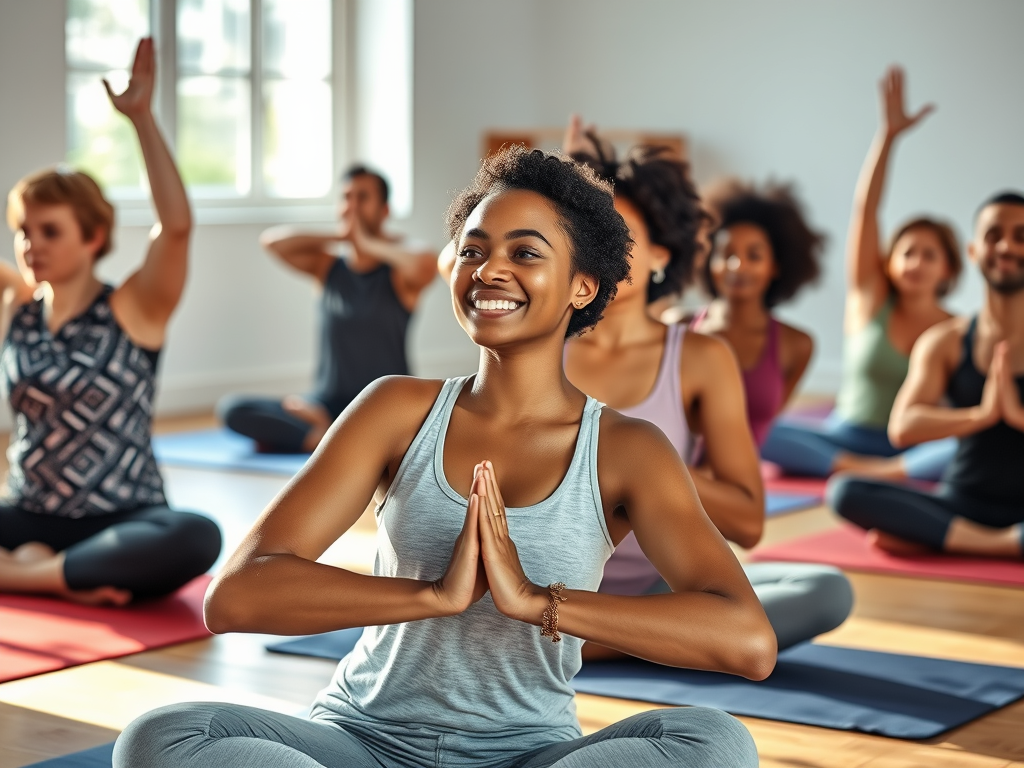
8) Can yoga be a way to build social connections and combat ADHD isolation? 🤝
Kim: Yoga creates beautiful opportunities for connection, especially important for ADHD women who sometimes feel misunderstood:
- Partner yoga creates safe, structured social interaction.
- Group breathing practices foster a sense of community even through a screen.
- Sharing circles after practice help normalize ADHD challenges.
My online classes include optional community elements where participants can choose their level of interaction – camera on or off, talk or don’t talk – you decide. Sometimes just practicing alongside others, even virtually, creates that sense of “we’re in this together” that’s so valuable.
The beauty is that yoga communities often naturally attract people who value neurodiversity – creating spaces where your ADHD traits might be seen as gifts rather than problems.
9) How can women adapt their ADHD-friendly yoga practice across different ages and energy levels? ⚡
Kim: Our ADHD symptoms and needs evolve throughout life, just like our hormones, and yoga can adapt right along with us:
- Teens and young adults: Dynamic practices that match high energy levels while building executive function skills through sequencing and focus.
- 30s and 40s: Balancing practices that support career demands and possibly parenthood – stress management becomes key here. Quick 15-minute classes are designed specifically for this busy life stage.
- Perimenopause and menopause: Hormonal fluctuations can actually intensify ADHD symptoms! Yoga that supports hormonal balance, like gentle inversions and cooling breath practices, becomes especially helpful.
- Older adults: Focus on maintaining mobility, balance and cognitive function with gentle but consistent practice.
The beauty of yoga is its adaptability – my online classes include modifications for different life stages and energy levels.
10) What are some practical ways to create an ADHD-friendly yoga space at home? 🏡
Kim: Setting up a yoga space that works with (not against) your ADHD can make all the difference in consistency:

- Visible Reminders – Keep your mat out where you can see it (out of sight, out of mind is real for us!)
- Dedicated Space – Even a small corner that’s always ready for practice reduces transition barriers.
- Sensory-Friendly Environment – Consider lighting (natural is best), sound (white noise machine if needed), and temperature.
- Minimize Visual Clutter – Face a blank wall or simplified space during practice to reduce distractions.
- Props Within Reach – Have supportive props ready to grab so practice feels good in your body.
Remember that your ADHD-friendly space might look different from the minimalist yoga studios on Instagram, and that’s perfectly ok! The best space is one you’ll actually use.
Imperfect practice is infinitely better than perfect intentions.
– Kim Pierpoint
11) How can busy ADHD women build a consistent yoga routine that actually sticks? ⏰
Kim: Consistency with ADHD? Yes, it’s possible with these strategies:
- Micro-Practices: My 15-minute classes are designed specifically because consistency beats duration every time.
- Habit Stacking: Attach yoga to something you already do daily (like brushing teeth or morning coffee).
- Visual Trackers: Create a simple calendar where you can see your practice consistency.
- Variety Within Structure: Have options like “dynamic day” or “gentle day” rather than forcing yourself into the same practice.
- Body-Led Timing: Notice when your body naturally wants to move and capitalize on those moments.
In my online classes, I encourage “choosing your own adventure” rather than forcing rigid schedules that fight against your ADHD brain. Remember: imperfect practice is infinitely better than perfect intentions!
12) Thank you, Kim! These tips are so valuable! 🙌🏼 Can you tell us a bit about yourself, your background and where people can find you?

Kim: My journey combining yoga and ADHD support began with my own diagnosis at the age of 51 . I already knew the transformative effect yoga had on my physical body as well as my mental health.
After experiencing how traditional yoga classes often didn’t accommodate neurodivergent needs, I now share approaches and techniques to educate yoga teachers, so they can create spaces to welcome neurodivergent people and to share my own story. In my own classes, workshops and retreats, I NEVER expect people to be still, or to EVER empty their minds. I create a space that suits my ADHD and allows me to teach a wide range of people including neurodiverse individuals. All my classes work with rather than against the ADHD brain.
I offer weekly live online classes, as well as an OnDemand library of classes. Classes range from energizing 15-minute flows to deeply restorative somatic practices that work directly with the nervous system. Every class includes modifications for different energy levels, focus capabilities, and physical needs.
Find me here:
🌟 Website: kimpierpoint.co.uk
🌟 Instagram: @kimpierpointuk & @yogaforadhduk
🌟 Facebook Group: Perimenopause & ADHD Support
🌟 Online Classes: Join Here
🌟 Free ADHD Yoga Tips: 20 Tips for Joining a Yoga Class with ADHD
Current Offerings:
🧘 15-Minute Morning Flows – Quick practices for busy days
🌀 Stretchy Sundays – Somatic practices for regulation
⚡ Dynamic – Flow – Classes that match your energy then guide it to balance
🌿 Hatha Yoga – An easy class for newbies and great for neurodivergent bodies and minds
Join me on the mat and discover how yoga can be a superpower for your ADHD brain rather than another “should” on your list!
FINAL THOUGHTS:
Here’s the deal—yoga isn’t about sitting still or silencing your thoughts. It’s about moving in a way that works for you. Whether you need a quick burst of energy, a grounding reset, or a class that flows with your mood, Kim’s got you covered.
Yoga can be a supportive tool for your ADHD journey—helping you embrace your strengths, regulate emotions, and find peace in the beautiful chaos of your mind. With zero pressure to be “perfect,” every class is designed to meet you where you are.
Ready to move in a way that actually feels good? Kim’s got your back—now go roll out that mat!

Looking for ADHD-Friendly Fitness & Wellness Ideas? 💌
Join a community that understands your unique energy and needs as an ADHD sister. Receive monthly tips, creative movement & momentum ideas, fitness inspiration and routine-building strategies to help you stay active, focused, and fulfilled—one small step at a time.
👉 Sign up for our newsletter and start making wellness work for you today! ✨
Resources List:
- Kim Pierpoint’s Online Yoga Classes: Kim offers live online yoga sessions that provide real-time feedback in a supportive and fun environment. Her classes are suitable for all levels and can be accessed at kimpierpoint.co.uk
- Article: Get Your Top tips for Joining a Yoga Class with ADHD
- Eco-Friendly Cork Yoga Mat – This non-slip, sustainable yoga mat features a natural cork surface for superior grip, alignment lines for guidance, and a tree rubber base for extra support — t’s perfect for ADHD-friendly movement — stable, easy to clean, and travel-friendly. 🌿✨
Comments